Amazon (NASDAQ: AMZN), Meta (NASDAQ: META), Google (NASDAQ: GOOG), and Microsoft (NASDAQ: MSFT) are allocating more than $320 billion to AI infrastructure in 2025, including chips, data centers, and large-scale models. However, these tech giants are facing an energy supply crunch right at the peak of their AI model performance.
Goldman Sachs forecasts data center power demand will increase by 50% by 2027 and 165% by 2030. In response, Big Tech companies are investing in nuclear real estate or securing long-term agreements with nuclear power providers, such as Meta’s 20-year agreement with Constellation Energy.
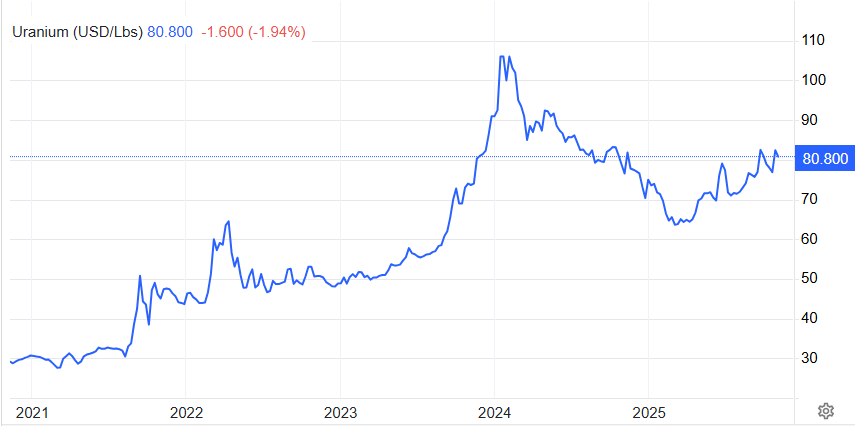
The viability of nuclear energy depends on its primary fuel: uranium. However, global uranium inventories are declining, and production targets are being missed. Uranium spot prices reached $110/lb in late 2024, its highest level in nearly two decades, before consolidating around $80/lb by November 2025. With supply limitations increasing, analysts predict a return to prices exceeding $100/lb, benefiting uranium miners as the market shifts in their favor.
Junior uranium explorers, particularly those that operate in Canada’s Athabasca Basin, the highest-grade uranium region globally, are positioned to bridge the supply gap while increasing their value. Investors looking to cash in on this bull market should consider undervalued uranium stocks as they offer direct exposure and biggest upside potential.
With Big Tech embracing nuclear energy and uranium’s strong outlook, momentum remains firmly on its side.
Why Big Tech Is Going All-in on Nuclear
Big Tech’s $320 billion AI infrastructure push in 2025 is tied directly to energy strategy. Tech giants are moving past reliance on grids or intermittent renewables, integrating nuclear power to ensure a 24/7 supply for AI workloads that use 33 times more power than traditional computing.

Meta recently locked in a 20-year agreement with Constellation Energy to secure clean, around-the-clock nuclear power for its operations. It’s not the first; last year, Microsoft’s 20-year, $16 billion deal with Constellation Energy went beyond power procurement, including investments in small modular reactors.
Google has also secured more than 2.5 gigawatts of nuclear capacity, 500 MW from Kairos Power, 1.8 GW from Elementl Power, and 200 MW from Commonwealth Fusion Systems, to strengthen its long-term energy portfolio. Oracle (NYSE: ORCL) plans to commit $100 billion to nuclear energy projects.
Amazon is taking a dual approach. In addition to channeling $20 billion into nuclear-powered, AI-driven data center campuses, it is also investing more than $500 million in dedicated nuclear development projects. These moves build on major site acquisitions and energy agreements made by the company in 2024, including partnerships to lock in nuclear-backed power and explore on-site reactor development.
Tech leaders are becoming direct stakeholders in nuclear energy. As the world and AI’s energy demand accelerates, the uranium supply chain is coming under sustained pressure. Producers face output shortfalls, new projects are delayed, and long-term contracts are being signed at increasingly higher prices.
The market has yet to fully account for the structural deficit forming in the uranium supply and the positive implications for uranium producers.
Uranium’s Market Outlook Points to Investment Opportunities in Mining
The 2025 Uranium Red Book forecasts that the global uranium supply could be exhausted in the following decades, driven by clean energy mandates and the exponential growth of AI-powered data centers.
While spot prices appear steady, the term market tells a different story: contract prices are up 23% year-over-year as utilities race to lock in supply ahead of expected deficits. This gap between today’s prices and analysts’ forecasts signals a compelling opportunity.
For uranium stock investors, higher prices don’t just mean a stronger commodity; they can translate into bigger margins for producers, higher valuations for explorers, and the kind of re-rating that can send well-positioned, undervalued stocks climbing fast as the market adjusts to looming shortages. Canada is already close to securing a 10-year, US$2.8 billion uranium deal with India, reinforcing long-term demand, but even this covers only a small portion of what the market will need. That gap is where junior miners come in.
Emerging, well-positioned uranium developers stand to benefit the most. As the next phase of the nuclear buildout accelerates, undervalued companies with assets in regions like Canada’s Athabasca Basin will offer early exposure to what could possibly be the most strategic commodity of the next decade.
Disclaimer: TrueNorth News Inc., its employees, and its marketing partners have no stock, option, or similar derivative position in any of the companies mentioned, and have no plans to initiate any such positions. Past performance does not guarantee future results. Nothing in this material should be interpreted as a recommendation or advice that any specific security, portfolio, transaction, or investment strategy is suitable for any individual. This article was created and researched using artificial intelligence, using publicly available information. The author is not providing personal advice regarding the nature, potential, value, or suitability of any particular security or matter. You alone are responsible for determining whether any investment, security, strategy, product, or service is appropriate for your financial objectives and personal circumstances. Any views or opinions expressed herein may not reflect those of TrueNorth News Inc. as a whole. TrueNorth News Inc. is neither a licensed securities dealer, broker, U.S. investment adviser, nor an investment bank. These materials constitute sponsored content and do not represent a recommendation to buy or sell securities. TrueNorth News Inc. is in a marketing partnership with CIBIDI CORP., which is sponsoring this article on behalf of Kirkstone Metals Corp. CIBIDI CORP. has been retained and financially compensated by Kirkstone Metals Corp. to provide marketing and promotional services.