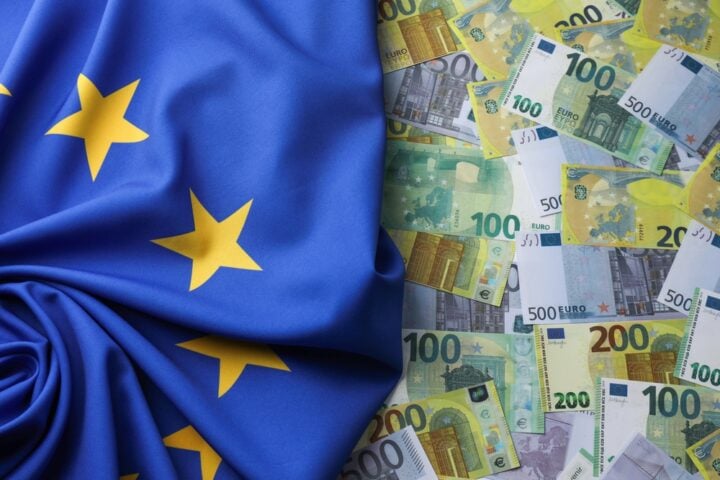
The euro has the potential to become a viable alternative to the U.S. dollar, providing immense benefits to the 20-nation bloc, but only if governments focus on strengthening Europe’s financial and security architecture, according to European Central Bank (ECB) President Christine Lagarde. Speaking at a lecture in Berlin on Monday, Lagarde acknowledged that global investors, disturbed by unpredictable U.S. economic policies, have been reducing their exposure to dollar assets, yet many have turned to gold instead of seeking a direct alternative.
The Stagnation of the Euro’s Global Role
Lagarde pointed out that the euro’s global role has stagnated for decades, primarily because Europe’s financial institutions remain incomplete and there has been little political appetite for further integration among EU member states. While the dollar’s dominance has been waning, now accounting for just 58% of international reserves—the lowest in decades—the euro still lags behind at just 20%. According to Lagarde, the euro cannot achieve greater influence by default; it must work to earn it.
Strengthening Europe’s Financial Infrastructure
To make the euro a stronger contender to the dollar, Lagarde argued that Europe needs to build a deeper, more liquid capital market, strengthen its legal frameworks, and demonstrate commitment to open trade alongside enhanced security capabilities. This, she believes, would provide the foundation for the euro’s rise on the global stage. The role of military power is also crucial, as investors tend to favor regions with reliable security partnerships that can back up economic influence with military strength.
Reforming Europe’s Capital Market and Economic Logic
While Europe has made strides in economic integration, the euro area’s capital market remains fragmented, inefficient, and lacking in a widely accessible, liquid safe asset that would attract investors. Lagarde emphasized that economic logic dictates that public goods must be jointly financed, and such financing could help Europe increase the supply of safe assets, enhancing its financial clout. However, joint borrowing, a key measure for more integrated financing, remains politically taboo in some countries, especially Germany, which is wary of the financial risks posed by less fiscally disciplined EU members.
The Potential Benefits of a Stronger Euro
If Europe succeeds in overcoming these barriers, the benefits could be enormous, according to Lagarde. A stronger euro would attract greater investment inflows, enabling domestic players to borrow at lower costs. It would also insulate the eurozone from exchange rate volatility and provide greater protection against international sanctions. To help make the euro the currency of choice for international trade, Lagarde called for new trade agreements, better cross-border payment systems, and liquidity arrangements with the ECB.
As Europe faces global economic shifts and increased geopolitical risks, Lagarde’s vision for the euro could transform it into a truly global currency, but only if significant political and economic reforms are made. For now, the challenge lies in overcoming the resistance to deeper integration within the eurozone.